

Quality assurance complaints received by seed companies most commonly relate to the germination and vigour of brassica seed. To ensure high standards, seed companies conduct various tests, including assessments for germination, vigour, diseases, seed count, genetic purity, and physical purity.
Seed grading ensures enhanced germination and vigour, leading to better uniformity in seed trays and improved field performance with higher cut percentages.
Although germination tests are widely recognised as indicators of seed quality, there is still limited understanding of the physiological processes involved in germination and how to interpret germination test results effectively.
The physiological process of germination
To seed physiologists, germination is the active growth of the embryo resulting in the rupture of the seed coat. Seed analysts, following ISTA (International Seed Testing Association) rules, include the emergence of the seedling in their definition, focusing on its development into a young plant. Germination can be described as the process that transforms the seed embryo into an independent, photosynthesising plant.
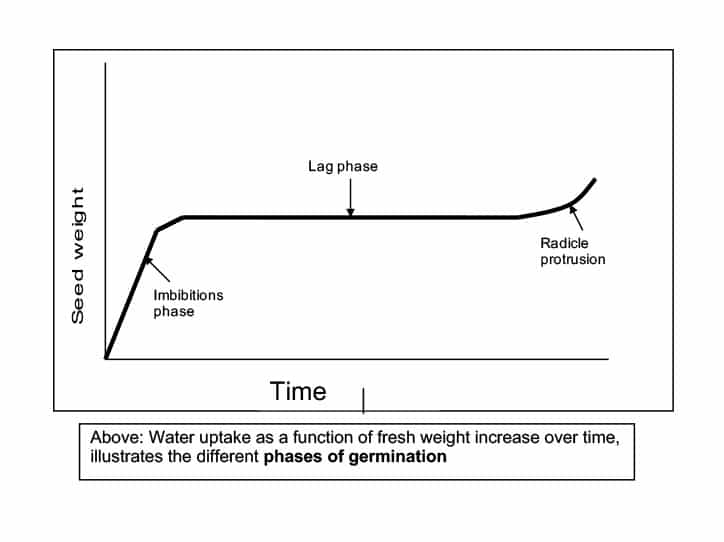
The germination process can be divided into three phases:
Imbibition of water:
Seeds readily absorb water through the seed coat. It is then diffused throughout the seed tissues. Water also softens then seed coat, making it more permeable to respiratory gases. The entire seed swells as the cells become turgid. This is a purely mechanical process and occurs in both viable and dead seed. During the first few hours of imbibition, the moisture content increases from about 5 to 70 %, which is evident by the rapid weight gain.
Lag phase (Plateau phase):
During this phase, there is no weight gain, but there is a general mobilisation of the seed’s food reserves. Enzymes are either activated or synthesized to catalyse (drive) reactions that convert insoluble carbohydrates, oils, and proteins into soluble forms, enabling plant growth. The phase concludes with the rupture of the seed coat and radicle protrusion, marking physiological germination.
Radicle emergence and seedling development:
The radicle (which becomes the primary root) emerges first, establishing contact with moist soil. The hypocotyl (stem segment below the cotyledons) elongates, pushing the seedling through the soil surface. In brassicas, the hypocotyl forms a protective arch for the growing point. Once exposed to light, the hypocotyl straightens, pulling the cotyledons above ground to function as leaves. These cotyledons provide energy through photosynthesis until the primary leaves develop.